What is
Robotic Bronchoscopy?
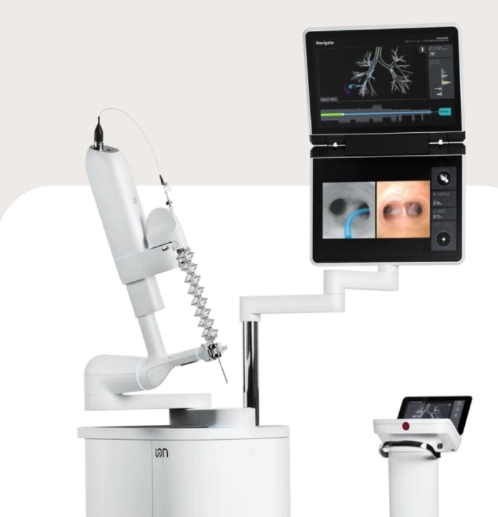
Robotic bronchoscopy is an advanced form of bronchoscopy in which a very thin, steerable catheter is guided through the airways under robotic control.
Working from a console, Dr Sidhu navigates the small peripheral airways with a planned route based on your CT scan, allowing biopsies to be taken from almost anywhere in the lungs.
What is Robotic Bronchoscopy?
Robotic bronchoscopy is an advanced form of bronchoscopy in which a very thin, steerable catheter is guided through the airways under robotic control.
Working from a console, Dr Sidhu navigates the small peripheral airways with a planned route based on your CT scan, allowing biopsies to be taken from almost anywhere in the lungs.
How does it work?
The procedure combines your CT scan with planning software to arrive at the biopsy target.
Planning from your CT
Your CT scan is used to build a three-dimensional map of the airways and to plan a route to the nodule.
Navigation under robotic control
After you are under anesthesia a thin, steerable catheter is advanced along a path from a console, with greater stability and reach than conventional bronchoscopy.
Confirming the target
Live X-rays are used to confirm the catheter is at the nodule.
Sampling
Various tools are used to obtained samples from the nodule.
Discharge
You are usually discharged home the same day unless there is an unexpected issue, and will be seen by Dr Sidhu 1-2 weeks later for the results.
How does it work?
The procedure combines your CT scan with planning software to arrive at the biopsy target.
STEP 01
Planning from your CT
Your CT scan is used to build a three-dimensional map of the airways and to plan a route to the nodule.
STEP 02
Navigation under robotic control
After you are under anesthesia a thin, steerable catheter is advanced along a path from a console, with greater stability and reach than conventional bronchoscopy.
STEP 03
Confirming the target
Live X-rays are used to confirm the catheter is at the nodule.
STEP 04
Sampling
Various tools are used to obtained samples from the nodule.
STEP 05
Discharge
You are usually discharged home the same day unless there is an unexpected issue, and will be seen by Dr Sidhu 1-2 weeks later for the results.
Why robotic bronchoscopy?
It is most often used when a nodule is small, peripheral, or hard to sample.
Reaches small and peripheral nodules that conventional bronchoscopy often cannot sample.
Steady, precise catheter control, with the planned route visible throughout.
Diagnosis and staging can often be combined in a single anaesthetic.
Less invasive than surgery, with a lower risk of collapsed lung than a biopsy through the chest wall.
What to expect
Preparation and recovery are much the same as for a standard bronchoscopy.
You will be given instructions on fasting, and on adjusting medications such as blood thinners or diabetes medications.
The procedure is performed under general anaesthesia, so you will be asleep throughout.
It usually takes around 45 to 90 minutes, depending on the number of targets and whether lymph nodes are sampled.
You will be monitored until the anaesthetic wears off, and will need someone to drive you home. A sore throat or mild cough afterwards is common.
Report new or worsening symptoms such as bleeding, breathlessness or chest pain to your doctor, or present to your closest hospital if unwell.
Benefits, limits and risks
-
Benefits
Access to small and peripheral nodules, stable and precise catheter control, the ability to sample lymph nodes in the same sitting where indicated, and a lower rate of collapsed lung than a needle biopsy through the chest wall.
-
Limitations
Not every nodule is suitable as position and size can matter. A non-diagnostic result is still possible, and some patients will still need a different biopsy anyway.
-
Risks
Generally low, and similar to other bronchoscopic procedures: sore throat, cough, minor bleeding from biopsy sites, and less commonly collapsed lung or infection.
Benefits, limits and risks
Benefits
Limitations
Not every nodule is suitable as position and size can matter. A non-diagnostic result is still possible, and some patients will still need a different biopsy anyway.
Risks
Generally low, and similar to other bronchoscopic procedures: sore throat, cough, minor bleeding from biopsy sites, and less commonly collapsed lung or infection.
Written and reviewed by Dr Calvin Sidhu, MBBS FRACP — Respiratory & Sleep Physician
Last reviewed: —
About Dr Calvin Sidhu