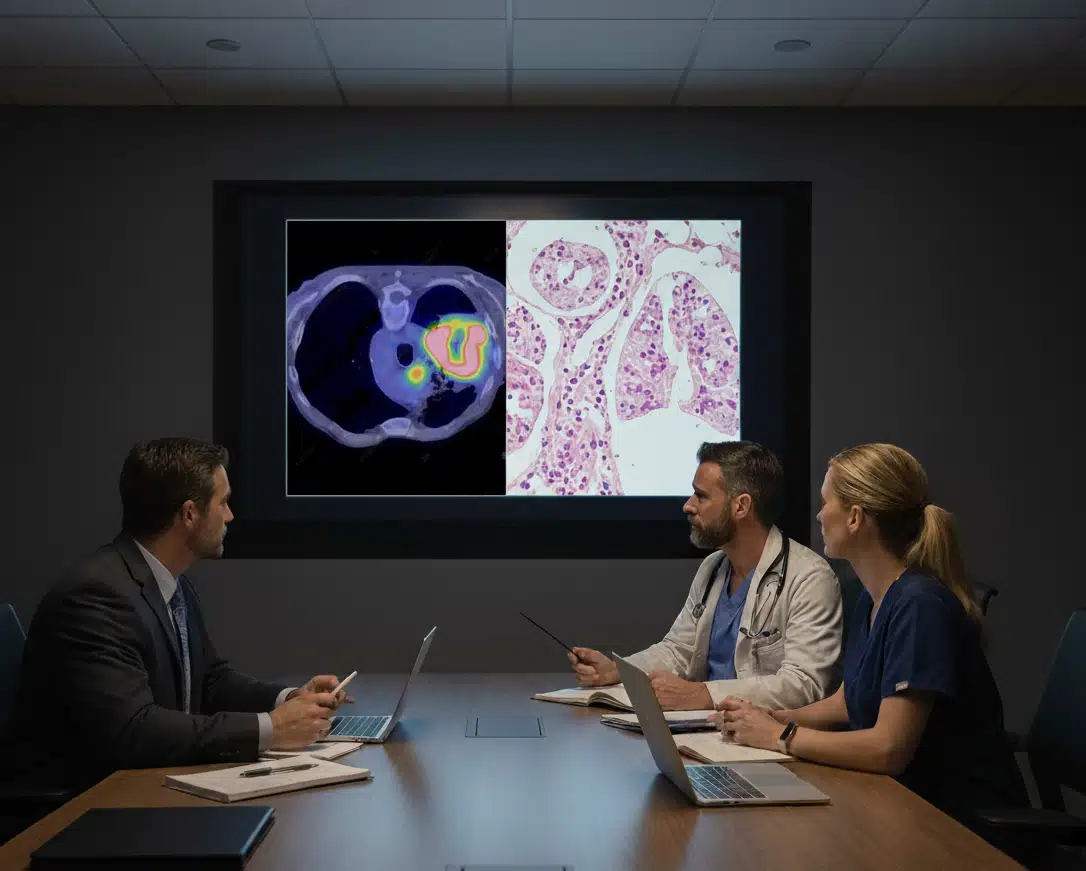
Bronchoscopy and pleural procedures are used for two broad purposes, to find out what is causing a problem in the lungs, airways or pleural space, or to treat the problem itself. Some procedures can do both, or be combined, in a single sitting.
Patient Information
What are these procedures for?
Bronchoscopy and pleural procedures are used for two broad purposes, to find out what is causing a problem in the lungs, airways or pleural space, or to treat the problem itself. Some procedures can do both, or be combined, in a single sitting.
To obtain tissue or fluid so a diagnosis can be confirmed. For example sampling a lung nodule, a mass, an enlarged lymph node, an airway lesion, or fluid around the lung.
Therapeutic Purposes
To relieve symptoms and restore function — opening a narrowed airway, removing an obstructing lesion or a foreign body, clearing secretions, draining fluid from the pleural space, or reducing over-inflated lung in severe emphysema.
Procedure Descriptions
What each of the procedures listed are used for.
Diagnostic
Robotic bronchoscopy
To reach and biopsy small or peripheral lung nodules that conventional scopes cannot access, using a route planned from your CT scan.
Diagnostic and therapeutic
Flexible bronchoscopy
To inspect the airways, take biopsies, brushings or washings, and to clear secretions or manage bleeding.
Rigid bronchoscopy
Therapeutic
Used under general anaesthesia for larger interventions in the central airways — removing obstructing tissue or foreign bodies, and placing stents.
Diagnostic
Linear EBUS
Ultrasound-guided needle sampling of lymph nodes and masses that sit just outside the airway wall — central to staging lung cancer and to assessing enlarged lymph glands.
Diagnostic
Radial EBUS
Confirms the position of a peripheral nodule during bronchoscopy, so a sample is taken from the target rather than the surrounding lung.
Diagnostic and therapeutic
Cryobiopsy
Freezes and removes a larger, better-preserved piece of tissue — useful in interstitial lung disease and where standard forceps biopsies are inconclusive.
Therapeutic
Electrosurgery
Uses heat energy through the bronchoscope to remove or debulk lesions in the airway and to control bleeding.
Therapeutic
Bronchoplasty / dilatation
Opens a narrowed airway (tracheal or bronchial stenosis) with balloon dilatation, and stenting where needed, to relieve breathlessness.
Therapeutic
lung volume reduction
For selected patients with severe emphysema: small prostheses are placed in the most damaged lung segments to reduce over-inflation and ease breathlessness.
Therapeutic
Indwelling pleural catheters
A soft tube left in the pleural space so recurrent fluid can be drained at home, avoiding repeated hospital procedures.
Diagnostic
Robotic bronchoscopy
To reach and biopsy small or peripheral lung nodules that conventional scopes cannot access, using a route planned from your CT scan.
Diagnostic and therapeutic
Flexible bronchoscopy
To inspect the airways, take biopsies, brushings or washings, and to clear secretions or manage bleeding.
Therapeutic
Rigid bronchoscopy
Used under general anaesthesia for larger interventions in the central airways — removing obstructing tissue or foreign bodies, and placing stents.
Diagnostic
Linear EBUS
Ultrasound-guided needle sampling of lymph nodes and masses that sit just outside the airway wall — central to staging lung cancer and to assessing enlarged lymph glands.
Diagnostic
Radial EBUS
Confirms the position of a peripheral nodule during bronchoscopy, so a sample is taken from the target rather than the surrounding lung.
Diagnostic and therapeutic
Cryobiopsy
Freezes and removes a larger, better-preserved piece of tissue — useful in interstitial lung disease and where standard forceps biopsies are inconclusive.
Therapeutic
Electrosurgery
Uses heat energy through the bronchoscope to remove or debulk lesions in the airway and to control bleeding.
Therapeutic
Bronchoplasty / dilatation
Opens a narrowed airway (tracheal or bronchial stenosis) with balloon dilatation, and stenting where needed, to relieve breathlessness.
Therapeutic
lung volume reduction
For selected patients with severe emphysema: small prostheses are placed in the most damaged lung segments to reduce over-inflation and ease breathlessness.
Therapeutic
Indwelling pleural catheters
A soft tube left in the pleural space so recurrent fluid can be drained at home, avoiding repeated hospital procedures.
How is the right procedure chosen?
The least invasive route that will answer the question reliably is usually preferred — but the right choice depends on your scans and your circumstances.